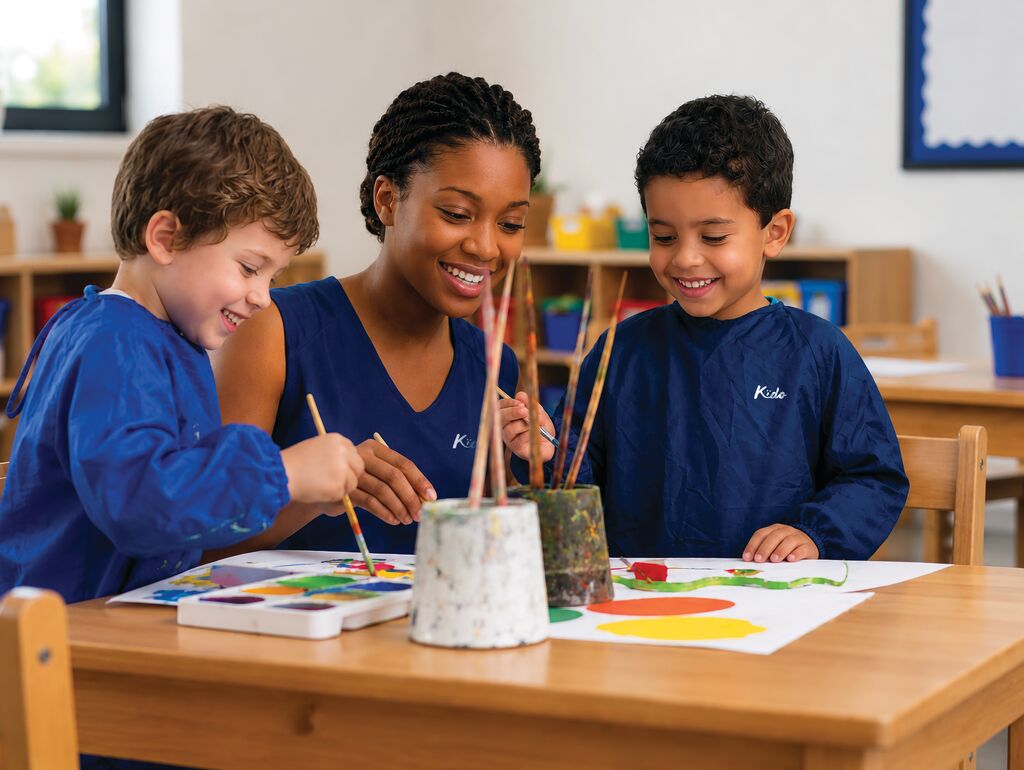
What Is the Difference Between Montessori and a Regular Preschool?
Helping parents understand different ways children learn
When choosing your child’s first preschool, should you look for Montessori, play-based learning or a programme that brings different approaches together?
It is a question many parents face when comparing preschools. Montessori follows a distinct educational philosophy with a strong emphasis on independence, hands-on learning and a carefully prepared environment. Other preschools may use play-based, child-led and teacher-guided experiences, or combine ideas from several early years approaches.
The important question is not simply which approach sounds best, but how that approach supports your individual child’s learning, development and wellbeing.
Key Takeaways
- Montessori follows a specific educational philosophy developed by Dr Maria Montessori.
- Montessori environments place a strong emphasis on independence, hands-on learning and child choice.
- Not all non-Montessori preschools follow the same approach; many combine play, exploration and teacher-guided learning.
- Both Montessori and other preschool approaches can support early literacy, mathematics, communication and social development.
- The quality of educators, interactions and learning experiences matters alongside the educational approach.
- Visit a preschool and observe how children actually learn before deciding what suits your child.
What is a Montessori preschool?
A Montessori preschool follows the educational approach developed by Italian physician and educator Dr Maria Montessori.
Children are encouraged to develop independence through hands-on experiences within a carefully prepared environment. Classrooms typically contain specific Montessori materials that children can access and work with, allowing them to explore areas such as language, mathematics, sensory development and practical life skills.
Teachers, often referred to as guides, observe children closely, introduce materials and support them as they gradually learn to work more independently.
The Association Montessori Internationale (AMI) describes Montessori environments as carefully prepared for child-centred learning, with accessible materials, opportunities for free choice and trained adults who observe and respond to children's developmental needs.
What is a regular preschool?
The term “regular preschool” can actually mean many different things.
Unlike Montessori, it does not describe one particular educational philosophy. A preschool may be play-based, child-led, theme-based, structured or influenced by several different early years approaches.
Children might learn through:
- Play and exploration
- Stories and songs
- Creative activities
- Outdoor experiences
- Role play
- Hands-on projects
- Group activities
- Teacher-guided experiences
For example, England's Early Years Foundation Stage (EYFS) sets standards for children's learning, development and care from birth to five. Importantly, the framework does not prescribe one particular teaching method. It recognises the importance of both child-led play and learning guided by adults.
This means that when comparing preschools, it is useful to look beyond the label and understand what learning actually looks like in the classroom.
What is the main difference between Montessori and a regular preschool?
The main difference is generally how the learning environment is organised and how children engage with learning.
In a Montessori classroom, children typically choose from carefully selected Montessori materials and may repeat an activity until they are ready to move on. The teacher observes, demonstrates how to use materials, and provides guidance when appropriate. AMI (National Montessori Internationale) describes the Montessori environment as supporting hands-on, self-directed and self-correcting learning.
Other preschool programmes may combine child choice with more frequent group activities and teacher-guided experiences. Children might move between imaginative play, stories, outdoor exploration, creative activities, projects and planned learning experiences.
Neither model should simply be about keeping children occupied.
In a high-quality early years environment, educators understand how children develop and use their interactions, observations and learning environment to support each child's progress.
Is Montessori more child-led than other preschools?
Montessori places a particularly strong emphasis on child choice and independence within a carefully prepared environment.
However, this does not mean children simply do whatever they want.
The Montessori teacher plays an important role in observing children, preparing the environment and demonstrating how particular materials are used. Children are then given opportunities to practise and explore more independently.
Other preschool approaches can also be child-led. The difference is that they may combine children's interests and choices with more frequent group learning, imaginative play and teacher-guided experiences.
So rather than asking only whether a preschool is “child-led,” ask:
How much choice does my child have during the day, and how do educators extend their learning?
Do Montessori children learn through play?
Yes, although learning can look different in a Montessori classroom.
Montessori children spend considerable time engaged in purposeful, hands-on activities. Practical life experiences, sensory materials, language resources and mathematical materials allow children to explore, practise and repeat skills.
A play-based preschool may place greater emphasis on open-ended experiences such as:
- Imaginative and role play
- Construction
- Art and creative expression
- Sensory exploration
- Outdoor play
- Music and movement
Play is recognised as an important part of children's development within the EYFS. The framework explains that children learn both by leading their own play and through play and learning guided by adults.
The question for parents, therefore, is not simply “Does my child play?” but “What is my child learning through these experiences?”
Do Montessori preschools teach reading and maths?
Yes. Montessori introduces children to early literacy and mathematics, often through concrete, hands-on materials before gradually progressing towards more abstract concepts.
Other preschools may introduce similar concepts through:
- Stories and books
- Songs and rhymes
- Games
- Manipulatives
- Group activities
- Conversations
- Everyday problem-solving experiences
For young children, the amount of academic content is only part of the picture. It is equally important to consider whether learning is appropriate for their developmental stage and whether children are building genuine understanding rather than simply memorising information.
The current EYFS identifies seven interconnected areas of learning and development, including communication and language, physical development, personal, social and emotional development, literacy, mathematics, understanding the world and expressive arts and design.
Is Montessori better than a regular preschool?
There is no single preschool approach that will suit every child.
Some children may enjoy the independence, order and repetition associated with Montessori environments. Others may particularly enjoy imaginative play, frequent group experiences, collaborative projects or a combination of child-led and teacher-guided learning.
Instead of focusing only on the preschool label, consider:
- How does my child learn?
Think about their interests, temperament, confidence and comfort with independence and structure. - What does a normal day look like?
Ask how time is divided between independent exploration, play, group experiences and teacher-guided learning. - How much choice do children have?
Find out whether children can follow their interests and make meaningful choices. - How do educators interact with children?
Observe whether adults listen, guide, question, encourage and extend children's thinking. - What materials can children explore?
Look at whether the environment offers engaging, age-appropriate resources. - How is play supported?
Ask about imaginative play, outdoor experiences, sensory exploration and opportunities to create. - How are literacy and mathematics introduced?
Look for learning that feels meaningful, engaging and appropriate for your child's age. - How is independence encouraged?
Notice whether children are given opportunities to make choices and manage age-appropriate everyday tasks. - How do children interact with one another?
Look for opportunities to communicate, collaborate, play together and build friendships.
How does Kido combine different early years approaches?
At Kido, we recognise that meaningful early learning does not have to come from a single educational philosophy.
Our Kido Early Years System (KEYS) draws inspiration from established early years philosophies and practices, including Montessori and Reggio Emilia, alongside the principles of the EYFS.
This allows children to experience a balance of purposeful play, exploration, independence, creativity and thoughtfully guided learning.
Rather than expecting every child to learn in exactly the same way, the approach gives educators opportunities to respond to children's interests, developmental needs and individual ways of learning.
Choosing the Right Preschool for Your Child
The name of an educational approach can tell you something about a preschool, but it cannot tell you everything about the experience your child will have there.
Look at the people as carefully as you look at the curriculum. Observe how educators interact with children, how thoughtfully the environment is organised and whether children appear comfortable, curious and engaged.
Most importantly, consider your child. The right preschool should provide an environment where they feel secure enough to explore, supported enough to try and inspired to keep discovering.
At Kido, our approach brings together purposeful learning, play, exploration, independence and creativity to support children throughout their early years.
Book a visit to a Kido centre and experience our approach to early learning firsthand.
FAQs
Montessori can provide many opportunities for children to develop independence, but a child does not need to be independent before starting. The environment itself is designed to gradually encourage children to make choices, complete tasks and take greater responsibility.
Yes. Montessori programmes can begin during infancy and toddlerhood. The Association Montessori Internationale identifies Montessori programmes for children aged 0–3 as well as programmes for children aged 3–6.
The amount and type of imaginative or pretend play can vary between Montessori and other preschool settings. Montessori traditionally emphasises purposeful activities and real-life experiences, while many play-based programmes use role play and imaginative play extensively.
A Montessori classroom is usually carefully organised with child-accessible furniture and learning materials arranged so children can select and return activities independently. The environment is intentionally designed to support children's developmental needs.
Yes. Although Montessori places considerable emphasis on independent activity, children can also participate in conversations, social interactions and collaborative or group experiences.
Yes. A preschool can provide rich opportunities for imaginative play, exploration, hands-on learning, outdoor experiences and teacher-guided learning without following the Montessori method.
Ask about the curriculum, educator qualifications, daily routines, child-to-educator ratios, opportunities for play and outdoor learning, how children's progress is observed, parent communication and how educators respond to individual children's needs.