How Can I Make Halloween Fun Without Scaring My Toddler?
Making Halloween fun, playful and age-appropriate for little ones.
Halloween can be exciting for adults and older children—but what happens when your toddler takes one look at a scary mask and wants nothing to do with it?
For young children, Halloween can feel very different. Costumes, unfamiliar faces, skeletons, loud sounds, and spooky decorations may excite one child and genuinely frighten another.
The good news is that Halloween does not have to be scary to be memorable.
For toddlers and preschoolers, it can simply be an opportunity to dress up, use their imagination, create, explore and enjoy something different with the people they trust.
Key Takeaways
- Halloween does not need to be scary for toddlers and preschoolers to enjoy it.
- Young children may not always understand that frightening costumes, masks and characters are pretend.
- Follow your child's response rather than expecting them to enjoy every Halloween experience.
- Avoid forcing children to interact with costumes, decorations or characters that frighten them.
- Focus on imaginative play, dressing up, stories, sensory experiences, movement and creativity.
- Choose costumes that are comfortable, safe and easy for children to move around in.
- Simple Halloween activities at home can be just as exciting as large celebrations.
- Reassurance from a trusted adult can help children manage unfamiliar Halloween experiences.
Is Halloween too scary for toddlers?
It can be. Toddlers and young preschoolers are still developing their understanding of what is real and what is pretend.
An adult may immediately understand that a witch, ghost or monster is simply someone wearing a costume. A young child may not.
The American Academy of Paediatrics (AAP) explains that preschoolers can become deeply absorbed in their imaginative world and may sometimes find it difficult to distinguish where fantasy ends and reality begins.
That is why something an adult immediately recognises as pretend may feel very real to a young child. Some children will happily walk towards an enormous inflatable ghost. Others may become frightened by a relatively harmless mask.
Both responses are understandable.
Rather than deciding that your child shouldn't be frightened because something isn't real, respond to what they are experiencing.
If they are scared, acknowledge it. “That mask looks scary to you. We don't have to go near it.”
Reassurance works better than trying to convince a frightened child that there is nothing to be afraid of.
How do I explain Halloween to a toddler?
Keep it simple. A toddler doesn't need to understand the history or traditions of Halloween to participate.
You might say: “Halloween is a day when people dress up, decorate and have some fun pretending.”
If your child sees someone in a costume, explain what is happening: “That's a person dressed up as a monster. It's a costume.”
You can even demonstrate this at home. Put on a hat, cape, or simple costume and let your child watch you put it on and take it off.
“Look—it's still Mummy underneath.”
The AAP recommends preparing toddlers for Halloween by talking about what will happen, reading Halloween books together, and even practising wearing their costume beforehand. It also reminds parents that young children need reassurance that the scary parts of Halloween are pretend.
And if your child simply doesn't want to participate?
That's okay too.
Why is my toddler suddenly scared of Halloween decorations?
Young children can develop new fears as their imagination and awareness of the world grow. Something they ignored last year may suddenly seem frightening this year.
Halloween can also involve several unusual sensory experiences:
- Darkened rooms
- Flashing lights
- Loud sounds
- Large decorations
- Masks
- Skeletons
- Unexpected movements
- Unfamiliar people in costumes
For a young child, several unfamiliar things happening at once can feel overwhelming. Watch your child's body language.
If they hide behind you, turn away, cry, freeze or repeatedly ask to leave, give them space. You don't need to make them touch the decoration or stand beside it for a photograph to prove that it is safe.
Feeling safe is more important than participating.
What should I do if my child is scared of someone in a Halloween costume?
Don't force the interaction. Allow your child to stay close to you and observe from a distance.
You can calmly explain: “That's a person wearing a costume.”
If appropriate, and if the person is someone your child knows, seeing them remove part of the costume may help. But if your child still does not want to approach, respect that.
Avoid saying:
- “Don't be silly.”
- “There's nothing to be scared of.”
- “Look, everyone else is doing it.”
The AAP advises parents not to belittle children's fears. Instead, children may need reassurance and support as they gradually become more comfortable with something that frightens them.
Try:
- “I can see that you don't like that costume. You can stay with me.”
Once children feel secure, they may be more willing to explore at their own pace.
How can I make Halloween less scary for my toddler?
Start with the parts of Halloween that young children naturally understand and enjoy.
Think:
- Pumpkins rather than monsters.
- Dressing up rather than frightening masks.
- Silly stories rather than scary ones.
- Music and movement rather than sudden noises.
- Exploration rather than surprises.
You can introduce Halloween gradually through books, pretend play, crafts and conversations before attending a larger celebration.
Let your child know what will happen. “There will be people wearing costumes. There might be decorations and music. I'll be there with you.”
Knowing what to expect can make an unfamiliar experience easier to manage.
What are some fun Halloween activities for toddlers?
Halloween activities for young children do not need to be elaborate. The best ones give children opportunities to touch, create, move, imagine and explore.
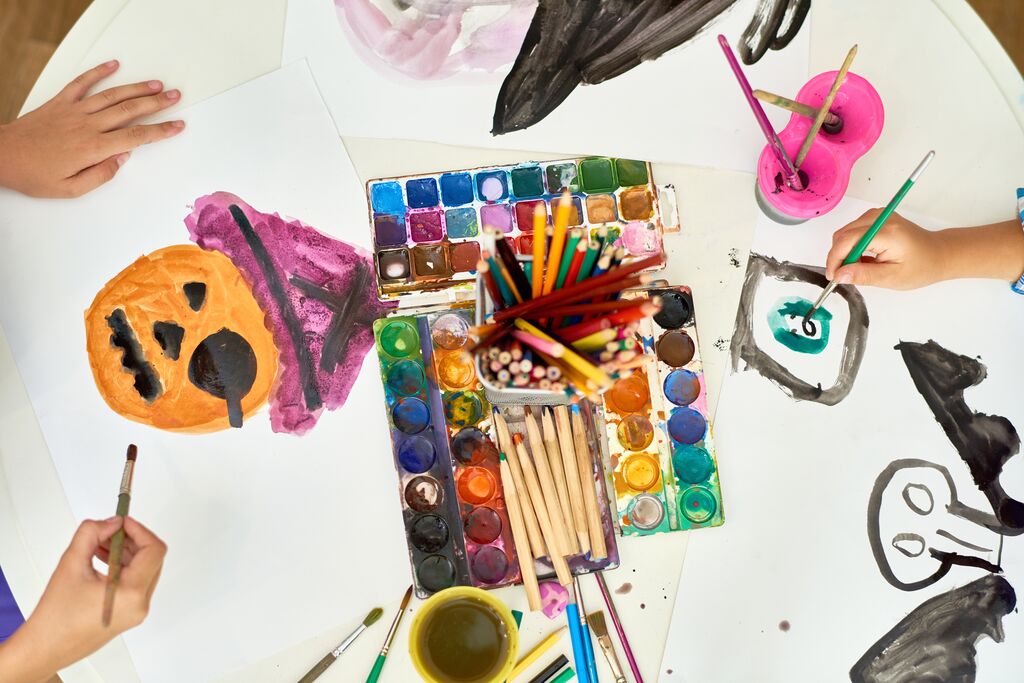
- Pumpkin Painting
Instead of carving a pumpkin, let younger children decorate one using washable paint, stickers or other child-safe craft materials. It encourages creativity without requiring them to handle sharp tools.
- Halloween Sensory Play
Create an age-appropriate sensory tray using materials such as orange playdough, large leaves, scoops, cups or child-safe Halloween-themed objects. Always consider choking hazards when choosing materials for younger children.
- Pumpkin Hunt
Hide pictures or toy pumpkins around a room or outdoor space and let children search for them. For younger toddlers, keep them visible and easy to find.
- Halloween Dance Party
Play music and invite children to move like different characters or animals.
- “Can you stomp like a monster?”
- “Can you fly like a bat?”
- “Can you creep quietly like a cat?”
Children get movement, imagination and plenty of silliness without anything genuinely frightening.
- Make a Funny Monster
Give children paper, crayons, stickers or craft materials and let them invent their own monster.
Ask:
- “How many eyes does your monster have?”
- “What does your monster eat?”
- “Is your monster noisy or quiet?”
Turning monsters into something silly and child-created can make the idea feel much less intimidating.
- Halloween Story Time
Choose age-appropriate books where Halloween characters are funny, friendly or adventurous rather than frightening. Pause while reading and let your child talk about the pictures.
- Dress-Up Play
Put out hats, scarves, capes, and simple costumes, and let children choose what they want to become. They do not need a perfect Halloween costume. A scarf can become a superhero cape. A cardboard box can become a robot. A hat can begin an entire imaginary adventure.
What are some non-scary Halloween costume ideas for toddlers?
For young children, comfort is more important than creating the most impressive costume.
Simple ideas include:
- Favourite animals
- Butterflies
- Ladybirds
- Dinosaurs
- Astronauts
- Doctors
- Firefighters
- Chefs
- Storybook characters
- Superheroes
- Fruits or vegetables
- Sunshine, stars or rainbows
You can also let your child's existing interests guide the choice.
If they love trains, animals or a particular story, start there. Halloween should not require children to dress as something frightening.
How do I choose a safe Halloween costume for my child?
Think about how your child will actually move while wearing it.
The U.S. Consumer Product Safety Commission (CPSC) recommends well-fitting costumes that don't drag on the ground, sturdy footwear, and masks that provide adequate ventilation and don't obstruct a child's vision.
For young children, check that:
- The costume fits properly and doesn't trail on the ground.
- Your child can see clearly.
- Shoes are comfortable and secure.
- Accessories do not have sharp edges.
- Small detachable parts do not present a choking risk.
- Your child can breathe and communicate comfortably.
- The costume is appropriate for the weather.
- Face coverings do not obstruct vision.
For very young children, simple costumes are often best.
If your child repeatedly tries to remove part of the costume, consider whether it is uncomfortable rather than insisting they keep it on.
Should toddlers wear Halloween masks?
For very young children, masks are often unnecessary. Masks can restrict vision, feel uncomfortable and make it harder for children to recognise familiar people.
Some toddlers may also become frightened when they see themselves or someone they know wearing one. The CPSC advises that if a child wears a mask, it should fit securely, provide adequate ventilation, and allow full vision.
For toddlers, a hat, headband, or simple costume is often easier than covering the face. If you use face paint, choose a child-appropriate product and follow the manufacturer's safety instructions.
What if my child refuses to wear their Halloween costume?
Let them. Halloween is supposed to be enjoyable.
A child who loved their costume at home may refuse to wear it when the celebration begins. They may feel uncomfortable, overwhelmed or simply change their mind.
Try offering part of the costume: “Would you like to wear just the cape?”
If the answer is still no, don't turn the costume into a battle. Children can participate in Halloween without dressing up.
How can Halloween encourage learning through play?
For young children, celebrations can create plenty of natural learning opportunities. Painting a pumpkin can encourage creativity and fine-motor development. A pumpkin hunt involves movement, observation and problem-solving.
- Dress-up encourages imagination and storytelling.
- Making pretend potions can introduce concepts such as pouring, measuring, mixing and cause and effect.
- Songs and movement build coordination and language.
- Stories introduce new vocabulary and ideas.
According to the American Academy of Paediatrics, pretend play gives children opportunities to use their imagination while strengthening language, social-emotional skills and creative thinking.
Dressing up and taking on different characters can be much more than Halloween fun—it can become meaningful early learning.
The learning does not need to be announced to the child. They can simply enjoy the experience. Play is often where the learning happens.
How can preschools celebrate Halloween without frightening young children?
Design early years Halloween celebrations with children's ages and developmental needs in mind. That may mean replacing horror with imagination.
Instead of frightening characters, sudden scares or dark environments, preschools can focus on:
- Dress-up and pretend play
- Pumpkin-themed activities
- Art and craft
- Music and movement
- Storytelling
- Sensory exploration
- Simple STEM activities
- Outdoor games
- Child-friendly decorations
Children should also be allowed to participate at their own comfort level. One child may enthusiastically dress up and join every activity. Another may prefer to watch for a while before taking part. A child-centred celebration makes room for both.
How does Kido make celebrations meaningful for young children?
At Kido, celebrations give children the chance to experience something beyond the ordinary day while continuing to learn through play, creativity, exploration, and interaction.
For young children, the most meaningful part of a celebration is often not understanding every tradition behind it.
It is participating. Creating something. Dressing up. Dancing. Listening to a story. Exploring something new. Laughing with friends.
These experiences let celebrations become part of children's learning while staying appropriate for their age and stage of development.
Halloween can be an opportunity for children to explore imagination, creativity and pretend play—without needing to be scary at all. Kido creates opportunities for children to explore, create, imagine and learn through meaningful experiences throughout the year.
Book a Centre Tour to discover how we bring learning to life through purposeful play and exploration.
FAQs
Yes. Halloween can be enjoyable for a two-year-old when activities are simple and age-appropriate. Focus on dressing up, pumpkins, music, stories, sensory play and family activities rather than frightening costumes or experiences.
It depends on the child. Some three-year-olds enjoy spooky characters, while others may genuinely believe they are real. Follow your child's reaction rather than assuming they should find something funny.
Keep it simple: “Halloween is a day when people dress up, decorate and have fun pretending.” Explain that costumes are pretend if your child seems unsure or frightened.
Young children may not immediately understand that there is a familiar person underneath a mask. Masks can also change a person's face, voice and appearance in ways that feel unfamiliar.
Move away from the frightening costume, stay close to your child and acknowledge their feelings. Explain calmly that it is a person in a costume, but don't force your child to approach.
No. Offer the costume and encourage them if they are interested, but avoid forcing it. Children can still enjoy Halloween activities without dressing up.
Pumpkin painting, simple sensory play, dancing, story time, a pumpkin hunt, drawing and dress-up are all easy options. Keep materials age-appropriate and supervise activities carefully.
Try pumpkin decorating, pretend potion-making, Halloween-themed art, treasure hunts, storytelling, dress-up, simple science experiments, baking and music-and-movement games.
Focus on pumpkins, friendly ghosts, animals, autumn colours, funny monsters, music, bubbles, storytelling and dress-up rather than horror-themed characters or jump scares.
For very young children, avoid masks that obstruct vision or breathing or make movement difficult. A hat, headband or simple costume may be easier.
Choose foods appropriate for your child's age and eating abilities. The AAP warns that Halloween can introduce choking hazards for babies and toddlers, including sweets and small novelty items. Check everything your child receives, and avoid anything inappropriate for their age or that poses a choking risk.
Yes. Costumes and pretend play give children opportunities to invent characters, create stories, use language and experiment with different roles.
Acknowledge the fear rather than dismissing it. Remind your child that costumes and Halloween characters are pretend, provide reassurance and temporarily avoid frightening content if it continues to worry them.
They can, provided celebrations are inclusive, age-appropriate and sensitive to children's individual comfort levels. For young children, the focus can remain on imagination, creativity, play and shared experiences rather than fear.
Try dressing up, decorating pumpkins, baking, a family treasure hunt, Halloween story time, music and dancing, simple crafts, or an indoor pretend-play activity. Halloween can be memorable without trick-or-treating.
Your toddler does not need haunted houses, frightening masks or elaborate Halloween plans to have fun.
- For young children, the memorable moments are often much simpler.
- Painting their first pumpkin.
- Dancing around the living room in a cape.
- Creating a very silly monster.
- Listening to a story with you.
- Or proudly deciding that today, they are going to be a dinosaur.
- Follow your child's cues.
- Keep experiences playful and age-appropriate.
- And if something frightens them, allow them to step away.